

Growth strategy
Designing beyond the screen: The future of websites in the AR era
The future of e-commerce is no longer limited to our smartphones' and laptops' two-dimensional screens. Imagine simply placing a perfectly scaled three-dimensional sofa model in your lounge with your phone, instead of browsing hundreds of photos. Or would you like to try on the latest watch, almost feeling its weight on your wrist, without leaving home? This is no longer a science-fiction film's vision, but a rapidly developing reality driven…
On this page
- 01Why are traditional websites no longer sufficient in e-commerce?
- 02How is augmented reality (AR) already changing the rules of the game in e-commerce?
- 03Is virtual reality (VR) merely a gadget, or the key to complete immersion in e-commerce?
- 04How will AR and VR affect the future of SEO and digital marketing?
- 05What challenges and opportunities face companies wanting to enter the world of AR and VR?
- 06Summary
- 07Key Takeaways
The future of e-commerce is no longer limited to the two-dimensional screens of our smartphones and laptops. Imagine that, instead of browsing hundreds of sofa photographs, you simply place a perfectly scaled three-dimensional model in your living room using only your phone. Or perhaps you would like to try on the latest watch, almost feeling its weight on your wrist, without leaving home? This is no longer a vision from a science-fiction film but a rapidly developing reality driven by augmented (AR) and virtual (VR) reality technologies. Welcome to a world where websites stop being flat storefronts and become interactive, immersive spaces, blurring the boundary between the digital and physical worlds.
In this article, you will learn:
- How augmented reality (AR) is revolutionising shopping experiences by allowing customers to virtually "try" products in their own surroundings.
- What virtual reality (VR) means in e-commerce and how it creates entirely new, immersive shopping worlds, from virtual car showrooms to luxury boutiques.
- How new technologies will affect digital marketing, SEO and SEM, and why traditional metrics will no longer be sufficient.
- What role a professional marketing agency will play in this transformation as it evolves from designing websites to creating entire experience ecosystems.
- The practical steps and challenges involved in implementing AR and VR solutions on existing websites.
Why are traditional websites no longer sufficient in e-commerce?
Traditional websites in e-commerce have followed the same pattern for years: a product grid, photographs, descriptions and an "add to basket" button. This model worked, but now it faces a fundamental problem: the imagination gap. Customers must imagine how a product will look in their lives, leading to uncertainty, abandoned baskets and, most importantly, a high returns rate that can reach as much as 30-40% in the fashion industry.
User experience experts understand this problem very well. Don Norman, author of the iconic book "The Design of Everyday Things", emphasises the importance of "cognitive fit": how easily a user can translate information on a screen into real-world application. In standard e-commerce, this fit is poor. Even the best photographs fail to convey scale, material texture or how a piece of furniture will fit between a window and a chest of drawers. This is the gap immersive technologies fill. The statistics speak for themselves: according to research, interacting with a product in AR can increase conversion rates by as much as 94%.
The main limitation of flat screens is their lack of spatial context. Users are passive observers rather than active participants in the buying process. This causes so-called "analysis paralysis": the more photographs and measurements in centimetres there are, the harder it becomes to make a final decision. Technologies such as AR and VR break through this barrier by moving the product from an isolated digital space (the product page) directly into the customer's personal physical world. As a result, decision-making becomes more intuitive, emotional and grounded in real experience rather than speculation alone. Understanding this phenomenon is crucial to every company considering a forward-looking online sales strategy.
Several key reasons explain why the old model is becoming insufficient, and every modern marketing agency should analyse them:
- A lack of buying confidence: Customers worry that the product will not meet their expectations (the wrong size or colour, or a poor fit with the interior).
- High returns costs: Reverse logistics represents an enormous financial and environmental burden for companies.
- A price war: When all products look similar in flat photographs, price often becomes the only differentiating factor.
- Low engagement: Users spend less and less time on standard product pages, and their attention is scattered.
Moving towards immersive experiences is therefore more than a technological novelty. It is a fundamental change in the psychology of online shopping that allows a deeper customer relationship to be built and value to be offered beyond the product itself.
How is augmented reality (AR) already changing the rules of the game in e-commerce?
Augmented reality, or AR, is technology that overlays digital images and information on a view of the real world seen through a smartphone camera or special glasses. In e-commerce , its application is revolutionary because it is exceptionally accessible: most of us already carry a device capable of supporting AR in our pocket. This is not the distant future; it is happening here and now, and the technology's pioneers are already reaping the rewards of their innovation.
The best-known example is the IKEA Place app, which allows users to virtually "place" furniture in their own homes. Using SLAM (Simultaneous Localization and Mapping), the phone maps the surroundings and places a three-dimensional product model within them with millimetre accuracy and realistic lighting. Customers no longer have to measure walls and wonder whether a Billy sofa will fit in their living room: they can simply see it. This reduces buying uncertainty to almost zero. Another giant that has successfully implemented AR is L'Oréal, with its ModiFace app for virtually testing make-up. Female customers can see in real time how different shades of lipstick or eyeshadow look on them, which dramatically increases engagement and sales.
|
Company |
Example AR Application |
Key Customer Benefit |
Business Impact |
|
IKEA |
IKEA Place |
Visualising furniture in a real space |
Fewer returns, greater buying confidence |
|
L'Oréal |
ModiFace |
Virtually trying on make-up |
Increased conversion and engagement |
|
Warby Parker |
Virtual Try-On |
Matching glasses to the face |
Personalising the offer, reducing the barrier to purchase |
|
Gucci |
Sneaker Garage |
Virtually trying on shoes |
Building an innovative brand image, reaching Gen Z |
Technically, there are two main types of AR used in e-commerce:
- Markerless AR: The most popular type, requiring no special markers. The phone uses its sensors (camera, gyroscope and accelerometer) to analyse the surroundings and place objects within them (such as the IKEA Place example above).
- Marker-based AR: This requires pointing the camera at a specific marker, such as a QR code or an image in a catalogue. Once the marker is recognised, a 3D object appears in its place. Although less flexible, it is an excellent tool for bringing printed materials to life.
Implementing AR on websites is becoming easier through technologies such as WebXR which allow AR experiences to run directly in the browser without installing additional apps. This is a crucial step towards mass adoption. Companies such as Shopify already offer integrated tools for creating 3D models and implementing AR on product pages. This demonstrates that AR is no longer the domain of large corporations but is becoming an accessible tool for the wider e-commerce market.
Is virtual reality (VR) merely a gadget, or the key to complete immersion in e-commerce?
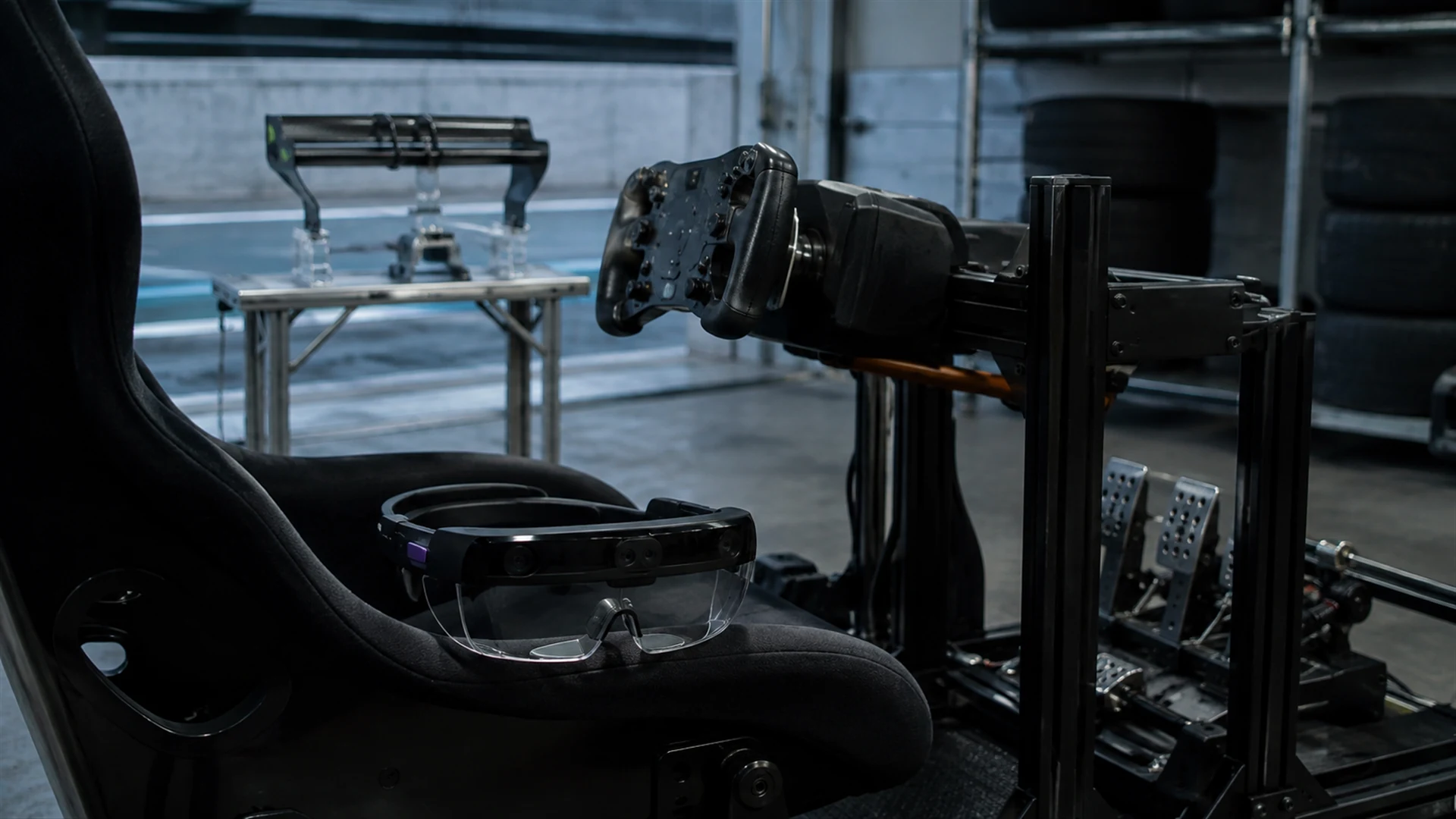
While AR augments our reality, virtual reality, or VR, replaces it entirely. By putting on a VR headset, users enter a fully digital, three-dimensional world, shutting out external stimuli. In e-commerce, VR offers something no other technology can provide: total immersion and the ability to create unique shopping experiences controlled by the brand that engage the senses in unprecedented ways.
Imagine a virtual car showroom. Instead of viewing photographs on a website, you put on a headset and "sit" behind the wheel of the latest Audi. You can look around the interior, touch the virtual dashboard, change the upholstery colour with a single hand movement and even take a virtual test drive along winding Alpine roads. This is not fantasy: it is Audi VR Experience which the German manufacturer introduced at its dealerships. Experiences like this build an exceptionally strong emotional bond with the product and brand. Another example is Alibaba and its Buy+ platform, which allows users to walk around virtual shopping centres, view products in 3D and make purchases with their gaze.
The key difference between AR and VR in e-commerce lies in the goal and level of engagement. AR is a practical tool helping with buying decisions within the context of the customer's existing reality. VR, by contrast, is a tool for storytelling and building the brand's world. It enables experiences that are impossible to recreate in the physical world. Think of an outdoor brand that, instead of showing tent photographs, lets a customer "pitch it" on the virtual summit of Mount Everest. This is the power of a virtual narrative, turning the buying process into an adventure.
Of course, VR still faces a hardware barrier: not everyone owns a VR headset. However, devices such as Meta Quest 2 are becoming more affordable and popular, opening the door to the mass market. Furthermore, the development of the Metaverse concept, promoted by giants such as Meta and Epic Games, suggests that virtual retail spaces will soon become an integral part of the internet. Companies already experimenting with VR are building competencies that will give them an enormous advantage in the future.
How will AR and VR affect the future of SEO and digital marketing?
Introducing AR and VR into mainstream e-commerce is not merely a change in website design but a genuine earthquake for the entire digital marketing ecosystem, including SEO and SEM. Existing strategies focused on keywords, links and flat content will need to evolve profoundly to adapt to a world where users do not just read and click but also interact with three-dimensional objects and spaces.
Let us start with SEO. Search engines such as Google already index and display 3D models in search results. This means optimising these assets is becoming a new branch of SEO, often called 3D Asset Optimization. Just as we optimise images for size and alt attributes, we will also need to optimise 3D models for:
- File size (poly count): Models that are too heavy will take a long time to load, negatively affecting user experience and rankings.
- File formats: Standards such as gltf and usdz are becoming crucial for compatibility with different platforms.
- Metadata: Describing models with structured data (Schema.org) will help search engines understand what an object represents.
Furthermore, engagement metrics, already an important ranking factor, will become more significant. Time on page will become less important than "time in the experience": how long users interact with a product in AR. Analytics will need to track not only clicks but also model rotations, changes in scale and successful "placement" of the product within a space. This is an entirely new dimension of data that a professional marketing agency will need to know how to analyse and use.
In paid campaigns (SEM), the possibilities become even more exciting. Imagine a Facebook advert that, when clicked, does not take users to a product page but immediately launches AR mode in the phone's camera, allowing them to try on the advertised shoes. This shortens the buying journey and provides instant gratification. Google is already experimenting with "Swirl" ad formats that allow interaction with a 3D model directly within an advertising banner. Formats like these will have much higher engagement (CTR) and conversion rates than their static equivalents.
The entire marketing strategy will need to shift from one-way communication (the brand talking to customers) to creating interactive worlds and experiences in which customers can participate actively. Content marketing will no longer be limited to writing blogs and creating videos but will encompass designing interactive VR scenarios or AR filters for social media. Harvard Business Review in its article "Why Every Organization Needs an Augmented Reality Strategy" emphasises that AR is not merely a marketing tool but a fundamental technology that will change how we interact with information, affecting every aspect of a company's operations.
What challenges and opportunities face companies wanting to enter the world of AR and VR?
Entering the world of AR and VR opens enormous opportunities for companies in the e-commerce sector, but also involves specific challenges that must be addressed consciously. This is not plug-and-play technology. Implementing it requires a strategic approach, investment and a change in how we think about a digital product. However, the reward for those accepting this challenge is enormous: gaining a competitive advantage for years.
One of the greatest challenges is creating and managing 3D assets. Unlike product photography, already a well-established process, scanning or modelling every product in 3D can be costly and time-consuming. It requires either employing specialists (3D artists) or using external companies' services. However, platforms such as Sketchfab and VNTANA are already emerging to automate 3D model optimisation and distribution, significantly lowering the entry barrier. The key is starting with a small group of the most important products to test the process and measure the return on investment (ROI) before the company decides to digitise its entire catalogue.
Another challenge is ensuring a high-quality user experience (UX). Poorly implemented AR or VR can be more frustrating than helpful. If a 3D model loads too slowly, AR tracking of the surroundings is inaccurate or the VR interface is unintuitive, users quickly become discouraged. This is why it is so important for these experiences to be designed by specialists who understand the characteristics of three-dimensional interaction. A good starting point is familiarising yourself with design guidelines for platforms such as ARKit (Apple) and ARCore (Google). Investing in good UX is absolutely crucial to successfully implementing immersive technologies.
Despite these challenges, the opportunities are virtually limitless.
- Increased personalisation: AR and VR allow experiences tailored to individual customers to be created. For example, the system can automatically match furniture to the style of a customer's interior by analysing the camera image.
- New business models: Brands can offer access to exclusive experiences in VR as a subscription service or create virtual events (such as fashion shows) and sell tickets to them.
- Deeper analytics: Analysing user behaviour in a 3D environment (for example, which product elements they look at longest or interact with) provides invaluable data that can be used to improve products and marketing strategies.
- A stronger brand image: Companies that are first to implement innovative AR/VR solutions position themselves as technological leaders and attract attention from the media and a new generation of consumers.
The future of websites and e-commerce lies in breaking through the barriers of the flat screen. AR and VR technologies are no longer mere curiosities but are becoming fundamental tools for building engagement, increasing conversion and creating unforgettable brand experiences. The path to full immersion requires learning and adaptation, but companies starting this journey today will shape the future of commerce in the coming decades. What was once the domain of imagination is becoming a standard expected by customers. The question is no longer "whether" but "when" your company will join this revolution.
Summary
We have reached the end of our journey through a world where websites escape the confines of flat screens. We have seen how augmented reality (AR) is becoming a powerful practical tool in e-commerce that allows customers to virtually try products and eliminates a crucial barrier to buying: uncertainty. We have discovered that virtual reality (VR) is not just a gadget but a new platform for telling brand stories, creating deeply immersive experiences and building an emotional bond that is almost unattainable in traditional online commerce.
This transformation is more than a technological novelty. It is a fundamental paradigm shift that will redefine marketing, SEO and how we think about customer interaction. The metrics we relied on will need to evolve, while the marketing agency's role will shift from designing interfaces to directing entire experiences. Challenges such as creating 3D assets or designing intuitive spatial interactions are real, but the opportunities they open, from hyper-personalisation to new business models, are worth every investment.
The future of commerce will not be viewed on a screen. It will be experienced in our living spaces. Companies that understand this and begin acting today will not only gain a competitive advantage but become the architects of a new era of digital interaction.
Key Takeaways
What is the most important difference between AR and VR for my e-commerce business?
Put simply, AR (augmented reality) is a practical tool helping customers make buying decisions in their own surroundings. It is a virtual fitting room for furniture, clothes or cosmetics. By contrast, VR (virtual reality) is an experiential tool allowing complete immersion and brand storytelling. It is a virtual showroom, driving simulator or exclusive fashion show.
Is implementing AR and VR only available to market giants?
Absolutely not. Although this was once the case, the entry barrier is much lower today, especially for AR. With technologies such as WebXR, AR experiences can run directly in the browser without creating a dedicated app. The biggest initial investment is creating 3D product models, but these costs keep falling, and e-commerce platforms (such as Shopify) offer more and more built-in tools.
What are the most measurable business benefits of implementing AR?
The main benefits, confirmed by market leaders, are:
- An increased conversion rate: Customers who have "tried" a product in AR are much more inclined to buy.
- Fewer returns: Visualising a product in a real context eliminates mistakes about size, colour or fit.
- Increased engagement: Interactive experiences attract attention and keep users on the website longer.
- Standing out from competitors: Innovation builds the image of a modern, customer-focused brand.
How will AR and VR change my approach to SEO and marketing?
Your strategy will need to go beyond keywords. A new field will emerge: 3D asset optimisation (3D Asset Optimization), allowing your products to appear in image and spatial search engines. Key metrics will also change: instead of "time on page", you will measure "time interacting with the product". New interactive AR advertising formats will appear in paid campaigns, shortening the buying journey to a single click.
What should my first step be if I want to begin using AR in my shop?
Start with small, measurable steps. Choose 5-10 of your best-selling products and invest in high-quality 3D models of them. Next, integrate a simple 3D viewer into your product pages with a "See in your room" (AR) option. Measure changes in engagement and conversion for these specific products. This will let you gather data and make an informed decision about scaling the project further.